

Expert HVAC Services in Waldorf, MD – Comfort Guaranteed
What’s That Noise? 5 HVAC Sounds You Shouldn’t Ignore
- 24/7 Live Answering
- Locally Owned – No Private Equity
- 10% Off Repairs for Government and Military Employees

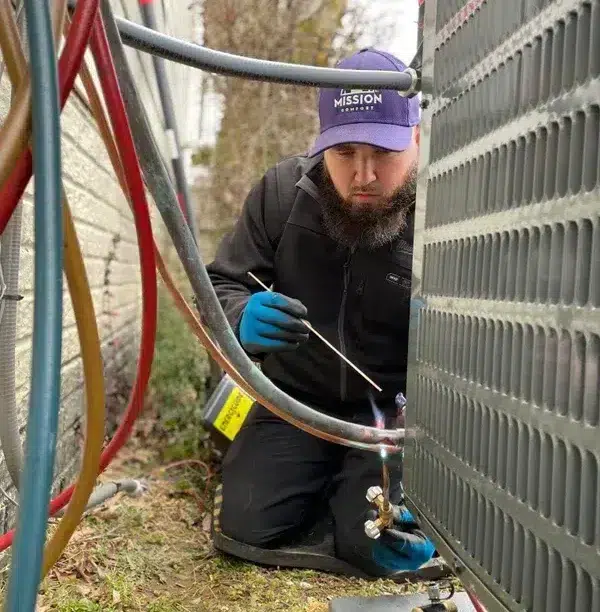
Your Waldorf HVAC system isn’t supposed to be the loudest thing in your house. A low hum when the system kicks on is normal, but anything beyond that — banging, grinding, screeching — is your system trying to tell you something.
The tricky part is knowing which sounds are minor and which ones signal a problem that could get expensive fast. At Mission Comfort, our HVAC team hears about these noises from homeowners across the DMV every week. Here’s a breakdown of the five most common HVAC sounds, what typically causes them, and when it’s time to call a professional.
1. Rattling
Rattling is one of the most common complaints, and it can mean several different things depending on where the sound is coming from. If it’s a light rattle near the vents, it could be something as simple as a loose duct connection or a register that needs to be tightened. Those are easy fixes.
If the rattling is coming from inside the unit itself — either the indoor air handler or the outdoor condenser — it could indicate loose internal components like fan blades, mounting hardware, or a deteriorating motor mount. Left alone, loose parts create additional vibration that accelerates wear on surrounding components.
When to call a pro: If the rattling is persistent, getting louder, or coming from inside the equipment rather than near the vents, it’s worth having a technician take a look before a minor issue becomes a bigger repair.
2. Grinding
A grinding sound almost always points to a mechanical problem with a motor or its bearings. In most cases, the blower motor bearings in your indoor unit have worn down, causing metal-on-metal friction. This isn’t a sound that fixes itself — it only gets worse.
In outdoor units, grinding can indicate issues with the compressor or the condenser fan motor. The compressor is one of the most expensive components in your system, so catching a grinding noise early can be the difference between a bearing replacement and a full compressor failure.
When to call a pro: Immediately. Grinding means something is wearing against something else, and the longer it runs, the more damage it causes.
3. Buzzing
Buzzing from your HVAC system can have several causes, and the location of the sound matters. A buzz from the outdoor unit often points to an electrical issue — a failing contactor relay, a loose wiring connection, or a capacitor starting to go. These components are responsible for starting and running the compressor and fan motors, and electrical problems can escalate quickly.
Buzzing can also come from a refrigerant leak, where the escaping gas creates a vibrating hiss near the coils. If you hear buzzing paired with reduced cooling performance, refrigerant could be the issue.
When to call a pro: Electrical buzzing should always be inspected by a licensed technician. These aren’t components homeowners should be troubleshooting on their own.
4. Squealing or Screeching
A high-pitched squeal at startup usually indicates a belt or bearing issue. In older systems that use belt-driven blower motors, the belt can become worn, cracked, or misaligned — producing that unmistakable screech when the system powers on. Newer direct-drive systems don’t use belts, but they can still produce a squeal if the motor bearings are failing.
In the outdoor unit, screeching may point to a compressor issue, particularly if the sound is new and happens under load. Compressor problems rarely resolve on their own and often signal that the system is nearing the end of its operational life.
When to call a pro: If the squeal happens every time the system starts up or persists while running, schedule a service call. A belt replacement is inexpensive, but ignoring it can lead to a blower motor failure or a system that stops circulating air altogether.
5. Clicking
Brief clicking when your system starts up or shuts down is perfectly normal — that’s the sound of relays and contactors engaging. But repeated, rapid, or continuous clicking is a different story.
Ongoing clicking often points to a failing thermostat signal, a faulty control board, or a relay that’s stuck trying to engage a component that isn’t responding. It can also indicate that the system is short-cycling, turning on and off in rapid succession because something is preventing it from completing a full heating or cooling cycle.
When to call a pro: If you’re hearing a click-click-click pattern that repeats without the system fully engaging, don’t ignore it. Short-cycling puts significant stress on your compressor and can shorten your system’s lifespan considerably.
The Bottom Line
Your HVAC system gives you warning signs before it fails. The homeowners who save the most money are the ones who pay attention to those sounds early and get them addressed before the problem compounds.
If your system is making any noise that’s new, persistent, or getting worse, don’t wait for it to become an emergency. Our team at Mission Comfort can diagnose the issue and give you a clear picture of what’s going on and what it takes to fix it — no guessing, no pressure.

Serving Charles County & Beyond
Searching for honest heating and air conditioning service in your town? That’s exactly what we do! We serve Prince George’s County, Charles County, Montgomery County, and many nearby areas.
 All Service Areas