

Expert HVAC Services in Waldorf, MD – Comfort Guaranteed
What Is a SEER2 Rating and Why Does It Matter When Buying a New AC?
- 24/7 Live Answering
- Locally Owned – No Private Equity
- 10% Off Repairs for Government and Military Employees


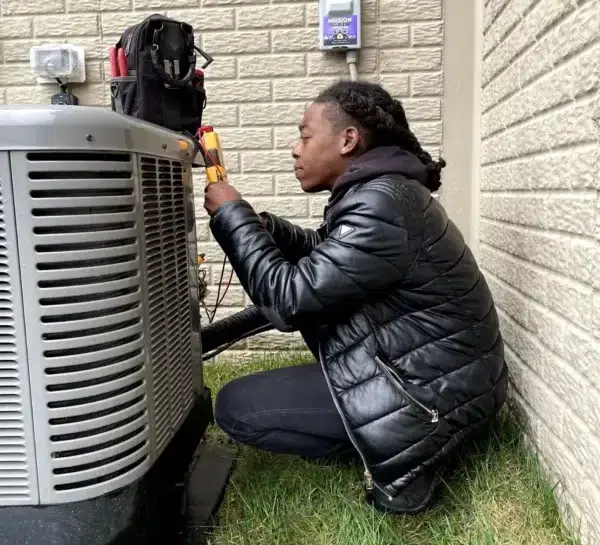
If you’ve started shopping for a new air conditioner or heat pump, you’ve probably come across the term SEER2 on spec sheets and contractor quotes. It might look like just another technical number, but understanding what it means — and what it doesn’t — can save you real money over the life of your system.
At Mission Comfort, our HVAC team will walk homeowners through this every time we quote a new Waldorf AC system. Here’s the plain-language breakdown.
SEER2: What It Stands For and What It Measures
SEER2 stands for Seasonal Energy Efficiency Ratio 2. It measures how efficiently an air conditioning system cools your home over an entire cooling season, not just at a single temperature point. The higher the number, the less electricity the system uses to produce the same amount of cooling.
Think of it like miles per gallon for your car. A system with a 16 SEER2 rating uses less electricity per unit of cooling than a system rated at 14.3 SEER2 — and that difference shows up on your energy bills month after month.
What Changed From the Old SEER Ratings
The Department of Energy introduced SEER2 in January 2023, replacing the original SEER rating system that had been in use since 1979. The key difference is in how the testing is done.
The old SEER tests were conducted under low-pressure conditions that didn’t reflect what happens in a typical home. Ductwork in real houses has bends, longer runs, and natural resistance from dust and wear. The old testing essentially gave systems credit for performance they wouldn’t deliver once installed.
SEER2 testing uses higher external static pressure that mimics actual residential ductwork conditions. The result is a more accurate picture of how the system will perform in your home, not just in a lab. Because the test is harder, SEER2 numbers run about 5% lower than old SEER numbers for the same equipment. A unit that was previously rated 15 SEER is now approximately 14.3 SEER2. The equipment didn’t get less efficient — the measurement just got more honest.
Maryland’s Minimum SEER2 Requirements
The federal government divides the country into regions with different minimum efficiency requirements based on climate. Maryland falls in the Southeast region, which has stricter minimums due to our longer, more demanding cooling seasons.
For 2026, the minimums in Maryland are 14.3 SEER2 for split-system air conditioners under 45,000 BTU (roughly 3.5 tons or smaller), 13.8 SEER2 for split-system AC units 45,000 BTU and above, and 14.3 SEER2 for heat pump systems regardless of size.
It’s illegal to install a new system that falls below these thresholds, so anything a reputable contractor quotes you will meet or exceed these numbers. The question is how far above the minimum you should go — and that depends on your home and your budget.
How Higher Ratings Translate to Real Savings
The difference between a minimum-efficiency system and a higher-rated one compounds over time. A system rated at 16 SEER2 is roughly 12% more efficient than one at 14.3 SEER2. In a climate like Maryland’s, where your AC runs heavily from May through September, that efficiency gap adds up quickly.
For context, if your current system is 15–20 years old, it was likely rated somewhere between 10 and 13 SEER under the old scale. Replacing it with even a minimum-efficiency SEER2 system represents a significant improvement, and stepping up to a 16 or 18 SEER2 unit can meaningfully reduce your monthly energy costs.
The key is matching the system to how you actually use it. If your AC runs eight or more hours a day during summer — which is common in Charles County, Prince George’s County, and throughout the DMV — a higher SEER2 system pays back its premium faster. If you’re in a smaller home with lower cooling demand, the base efficiency may be perfectly adequate.
What to Look for When Comparing Quotes
When you’re reviewing quotes from HVAC contractors, make sure you’re comparing SEER2 to SEER2. Some older marketing materials or inventory listings may still reference old SEER numbers, which makes a system look more efficient than it actually is under current testing standards.
Also keep in mind that SEER2 measures seasonal average efficiency. There’s a separate rating called EER2 that measures performance at a single high-temperature point (95°F), which is more relevant for peak summer performance. A good contractor will explain both numbers and help you understand what they mean for your specific situation.
Finally, the efficiency rating on the unit is only part of the equation. A high-SEER2 system installed with leaky ductwork, poor airflow, or incorrect sizing won’t deliver its rated performance. That’s why professional load calculations and proper installation matter just as much as the number on the spec sheet.
The Bottom Line
SEER2 ratings give you a more accurate way to compare systems and predict your energy costs. Maryland’s minimums ensure you’re getting a reasonably efficient system, but investing a step or two above the minimum often makes financial sense for homeowners who rely on their AC throughout the summer.
If you’re considering a new air conditioning system, Mission Comfort can help you compare options and find the right balance between upfront cost and long-term savings. We’ll size the system properly, explain the efficiency ratings in plain language, and make sure the installation is done right so you actually get the performance you’re paying for.


Serving Charles County & Beyond
Searching for honest heating and air conditioning service in your town? That’s exactly what we do! We serve Prince George’s County, Charles County, Montgomery County, and many nearby areas.
 All Service Areas